The complexity of cocoa
Our Global Head of Cocoa Sustainability, Andrew Brooks, talks about the recent changes and challenges in cocoa and our approach to de-risking the supply chain.
In the last three years, the cocoa market and subsequent prices have dramatically changed. How has this impacted cocoa sourcing?
The last three years have been marked by enduring volatility. Since 2023, we’ve seen some of the largest annual supply deficits on record and, consequently, the lowest stock-to-grinding ratio (the total available stock of cocoa beans to the total amount being processed in a given year) below 30% in 2023/24 crop season1. This was a 45 year low2, and resulted in prices increasing sharply in 2024, incentivizing farmers to increase their cocoa production. We have been able to navigate this production deficit thanks to our extensive origination and global sourcing network to maintain our global supply of cocoa. With an improved supply of cocoa in 2025, we expect to see higher stock-to-grinding ratios, and weaker market prices by the end of the year.
At the center of your sustainability program are the cocoa farmers the majority of whom are smallholders. How are you helping to tackle poverty and improve farmer incomes?
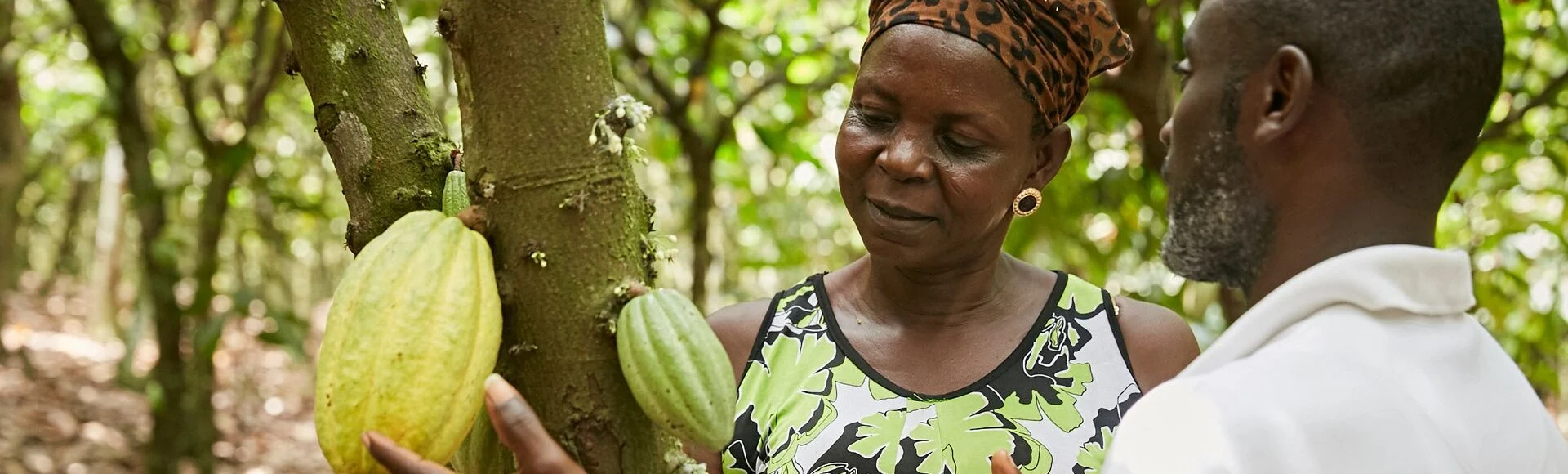
Farming cocoa is seasonal, with most of the world’s crops grown on family-run farms. Their income is influenced by many factors, such as small plots of land, weather, aging trees, soil health, and global commodity prices. Action to lift farmers out of poverty must start by understanding what level of income allows them to have a decent standard of living -‘a living income’. At ofi, living income is our north star for guiding our actions to support farmers to have more prosperous livelihoods. We’re using data-driven insights using our Cocoa Farmer Income Tool to better understand and help address living income challenges. This type of livelihood support can range from training in Good Agricultural Practices to improve yields and quality, distributing cocoa seedlings, implementing agroforestry access to youth service groups to provide more on-farm labor, in-kind benefits, and in some cases other farm crops for income diversification. We’re also supporting women entrepreneurs through business training and enterprise opportunities. Helping farmers achieve a living income requires holistic support with coordinated efforts by industry, national governments, and civil society.
Cocoa production is very sensitive to its environment and crop pests and diseases. What can be done to protect farmers from this risk?
Crop disease is a global industry issue but is particularly prevalent in Ghana and Côte d’Ivoire. Black Pod, and Cocoa Swollen Shoot Virus (CSSVD) transmitted by mealybugs, can have a devastating impact on a farmer’s harvest. To help minimize the impact of Black Pod on cocoa yields, we’re helping farmers with a combination of training on integrated pest management, effective pesticide use, and regenerative agricultural practices such as agroforestry which can help to create natural pest barriers in between crops. We’re working with the governments of Ghana and Côte d’Ivoire, as well as in industry research groups to build a roadmap that will help find a long-term solution for CSSVD.
With cocoa farming often run as a family business, what are the risks of child labor occurring and what is ofi doing to practically tackle the issue?
Child labor in cocoa, as in many other industries, doesn’t have a single cause. There are often complex and deep-rooted cultural, social and economic challenges at play. For example, it could be a lack of farm labor available or the ability to pay for it, no nearby schools or having the necessary documents to enroll their children in education. Sometimes labor laws are misunderstood or cannot be effectively enforced. The complexity of the issue means that one type of intervention will never be enough – it requires collective action and a range of long -term actions implemented at individual, community, and national levels. We have been working for two decades with customers, donor funding partners, governments, farmer groups and communities, with an initial focus on cocoa quality improvement and have evolved into tailored programs designed to put children first and tackle the root causes of child labor. A key milestone has been establishing child labor monitoring and remediation systems (CLMRS) across all managed sustainability programs in our nine sustainable cocoa sourcing countries. This enables us to identify children at risk of or in situations of child labor, as well as measure our progress in reducing and remediating child labor. Our community centered actions are focused on setting up child protection committees, and Village Savings and Loans Associations to help reduce poverty in cocoa communities, creating educational funds and establishing community service groups at farmer group level to facilitate access to adult labor. Additional remediation can also involve building and equipping classrooms, as well as obtaining birth certificates for children so they can attend school. Read more about our child labor prevention and remediation process.
What are you doing to tackle the impact of the cocoa supply chain on deforestation?
We are committed to using regenerative, tailored approaches across our supply chain to tackle deforestation and restore nature by working with farmers and their communities. We’ve scaled up our regenerative agriculture ambition to distribute 15 million beneficial trees (cumulative) and take a more holistic approach through establishing seven landscape partnerships by 2030. Since 2021, we’ve conducted 100% deforestation monitoring back to farms or the cocoa communities that we source directly to make sure cocoa is not sourced from any protected areas, reserves, or national parks. Via our Forest Loss Risk Index (FLRI), we monitor tree cover across nine cocoa-sourcing countries and have mapped 100% of the farms in our sustainability programs with either GPS pins or polygons. GPS pins use a radius approach to locate the farm, whereas GPS polygons trace a farm’s perimeter to verify that the volume of cocoa purchased respects the farm’s capacity. All suppliers to ofi either direct or indirect must sign our agri supplier code, which sets out our expectations for raw materials and products supplied to ofi. By signing, suppliers agree to specific terms in the code such as not sourcing or deliver products to ofi resulting to the destructions of important natural habitats including forests and adopting sustainable practices to protect species and their habitats, and important sites on and around the farm. Read more about our deforestation prevention and remediation process.
How are ofi’s preparations going for the European Deforestation Regulation (EUDR)?
Since our first cocoa sustainability initiative back in 2004, we have been developing systems and policies to support a more traceable and transparent cocoa supply chain. Our on-the-ground presence, integrated business model, systems and technology solutions, and sustainability programs, mean we are well-prepared to provide the required due diligence and digital traceability obligations for our cocoa products destined for the EU market when the regulation comes into application.
1. Based on ICCO figures.
2. Cocoa market under pressure; global deficit hits highest level in over 60 years.