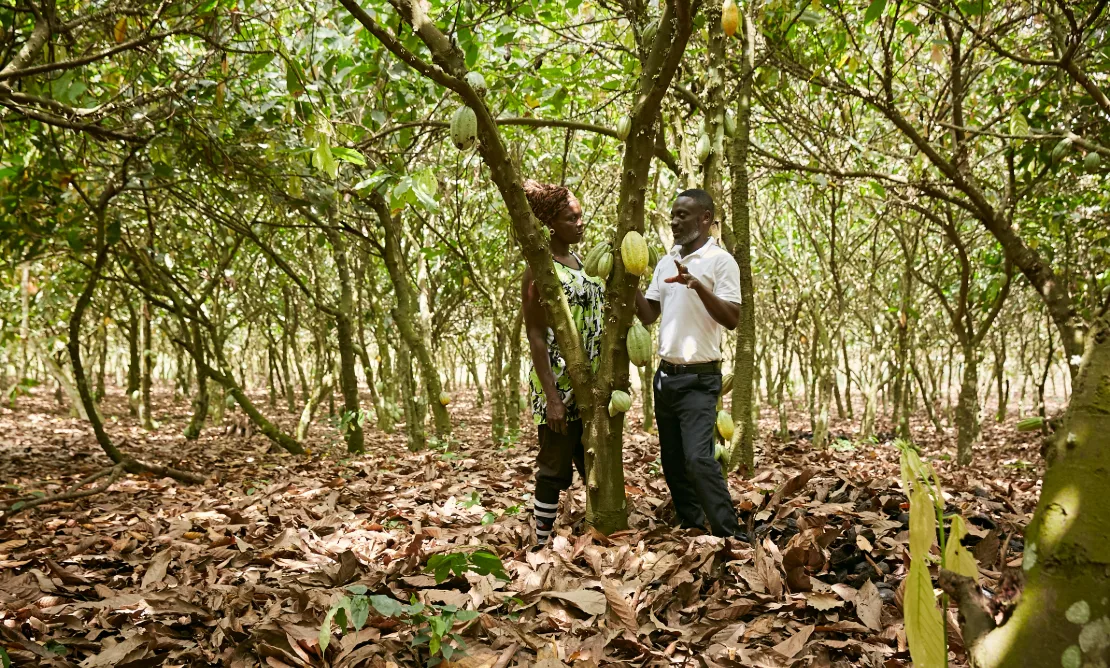
To support agroforestry adoption among cocoa farmers in Ghana and Cote d’Ivoire, over 2.6 million trees were distributed via ofi’s sustainability programs, including those it runs in partnership with its customers in 2025, a 92% increase from 2024.
In addition, 98,000 farmers received technical assistance from ofi in 2025 to optimize cocoa farming practices, and transition towards more regenerative agriculture
The practical support delivered by ofi’s local teams to farmers is designed to improve productivity, protect the environment and build resilience.
As a founding member of the World Cocoa Foundation’s Cocoa & Forests Initiative (CFI), ofi is publishing its latest annual progress update
Accra, Ghana, July 1, 2026 – ofi (olam food ingredients), a global leader in food and beverage ingredients and solutions, today reported progress made in 2025 to support a more regenerative cocoa production in Ghana and Côte d’Ivoire, as part of its membership of the Cocoa and Forest Initiative. This includes the distribution of 2.6 million multi-purpose trees1 through ofi’s sustainability programs, including those it delivers in partnership with its customers, representing a 92% increase compared to 2024.
In parallel, 98,000 cocoa farmers received technical assistance to strengthen farm management practices, improve productivity, and adopt more sustainable and regenerative agriculture practices such as agroforestry, pruning, and biochar.
Andrew Brooks, Global Head of Cocoa Sustainability, ofi said:
“ofi is embedded in many communities across Ghana and Cote d’Ivoire, working alongside our customers and industry stakeholders as a partner for positive change. We’re helping farmers to become more resilient by integrating regenerative practices that support better cocoa growing conditions and a more robust supply of cocoa for our global food and beverage customers."
“Using our Regenerative Agriculture framework, we’re now starting to assess farmers’ progress in implementing these regenerative practices so we can provide actions plans to optimize farming practices and enhance environmental outcomes”
In Ghana, alongside a customer, ofi is supporting farmers adopt biochar, which turns cocoa waste into a carbon-rich soil amendment which aims to improve soil health and reduce emissions. Biochar has the potential to support long-term carbon sequestration, restore soil structure, improve nutrient efficiency, and enhance moisture retention of the soil, helping cocoa growing conditions.
In Côte d’Ivoire, ofi continues to scale agroforestry with participating farmers receiving native tree varieties such as garcinia kola or bitter kola fruit species and fast-growing deciduous timber species like terminalia superba and ivorensis to create shade on the cocoa farm. Importantly, these trees do not host vectors of Cocoa Swollen Shoot Virus (CSV), a disease that continues to threaten cocoa yields in Côte d’Ivoire and Ghana.
This update forms part of ofi’s ongoing work under the World Cocoa Foundation’s Cocoa & Forests Initiative (CFI). As a founding member of CFI in 2017, ofi, along with 34 leading cocoa and chocolate companies and the governments of Côte d’Ivoire and Ghana, joined together to safeguard forests and promote climate-resilient, sustainable cocoa production.
With CFI’s second phase coming to a close, the new CFI strategy will focus on advocacy for Forest Protection and Restoration and Reporting Standardization, aligning data and measurement across global frameworks.
ofi aims to continue strengthening deforestation-free supply chains under its overarching strategy, Choices for Change, while supporting farmers to thrive and transition towards more forest-positive systems. By investing in practical solutions and strong partnerships, ofi seeks to build on this progress, supporting farmers across cocoa-growing regions while protecting the landscapes they depend on for the long term.
1 Multi-purpose trees – CFI definition: Tree species that are included on cocoa farms for primary purposes beyond providing shade. They may be chosen to provide economical and/or ecological benefits to the farm. This may include tree crops such as fruit, medicinal and/or timber trees for later harvest.