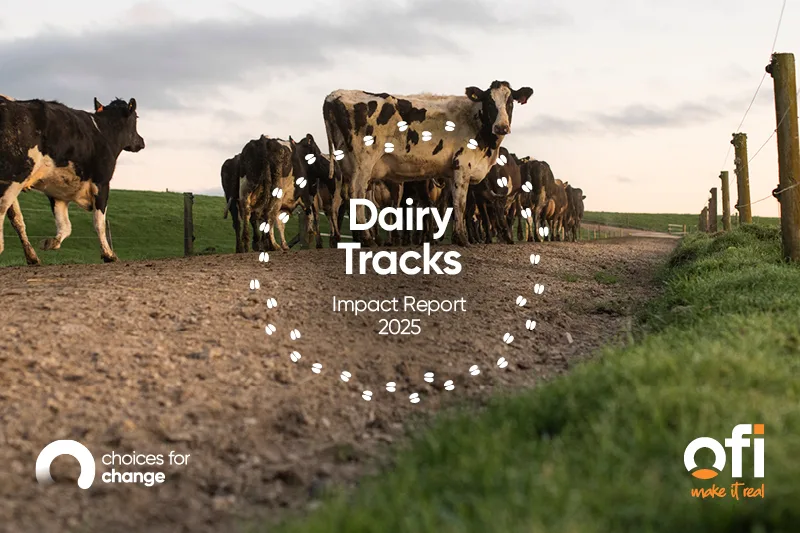
New farm-and facility-level data from ofi’s dairy supply chain show how the company is reducing emissions and helping customers in their efforts to lower product carbon footprints by planning supply with more confidence
London, UK, 19 May 2026 – ofi, a global leader in naturally good food and beverage ingredients, today published its 2025 Dairy Tracks impact report. It highlights how ofi is working with suppliers to help food and beverage manufacturers reduce dairy emissions, meet growing Scope 3 reporting requirements, and make more informed sourcing decisions.
As demand grows for credible, product-level carbon data, ofi is scaling supplier programs that turn farm and facility insights into measurable action. In 2025, primary data showed that farms in ofi’s dairy sustainability programs helped deliver around 80,000 MT of carbon reductions, taking ofi just over halfway to its 2030 Dairy Tracks ambition of 150,000 MT CO2e. Key levers included methane-reducing feed supplements, feed ration optimization, and improved manure management, contributing to progress against ofi’s science-based climate targets, which have been validated by the SBTi.
ofi sources and manufactures dairy ingredients and solutions, from milk powders to cheese and customized products, through a network of dairy suppliers, farmers, and its own processing facilities in Malaysia and New Zealand. In New Zealand, ofi sources milk directly from farmers. Dairy Tracks reflects this partnership approach.
Turning insight into action in 2025 under Dairy Tracks:
80,000 MT of carbon reductions delivered across ofi dairy programs (just over halfway to the 2030 ambition of 150,000 MT)
24,000 ha under regenerative practices across ofi dairy programs (48% of the 2030 ambition of 50,000 ha)
54% renewable energy across ofi’s owned dairy processing plants (towards a 2030 target of 60%))
61% of dairy volumes come with quantified primary product carbon footprints1, supporting product level reporting and decision making (building the data foundation needed to scale toward full coverage across all traceable dairy volumes by 2030)
2.9 billion servings of fortified dairy products produced (81% of the 2030 ambition of 3.6 billion), alongside livelihood support reaching 1,757 farmer households in Nigeria (35% of the 2030 ambition of 5,000)
Sandeep Jain, ofi CCO; CEO and Managing Director of Dairy, said:
“Dairy is a foundational ingredient across food and beverage – from drinks to ice cream and desserts – and plays an important role in nutrition for millions of people. But climate risks are already reshaping dairy supply chains, so customers need evidence they can use. That means data that stands up to scrutiny and translates into action. By combining primary data with scalable interventions and the knowledge of our expert teams, we’re helping brands protect both nutritional value and supply resilience, while moving from ambition to demonstrated, data-backed progress across participating programs.”
Andreas Zweifel, ofi Global Head of Dairy Sustainability and Climate Action, added:
“Farm level data allows us to pinpoint emissions hotspots and work directly with farmers and partners on targeted solutions. That means our customers gain clearer visibility of where reductions are happening and how they can be scaled across supply chains.”
The report also outlines how Dairy Tracks contributes to ofi’s wider Choices for Change sustainability strategy, with 2030 ambitions spanning climate action, farmer livelihoods, and ecosystem regeneration.
Notes to Editors
The Dairy Tracks 2025 impact report is available here.
ofi’s Choices for Change sustainability strategy sets out 2030 ambitions, including a target to cut Scope 3 emissions by 30% by 2030, to which Dairy Tracks contributes alongside other initiatives, and bring two million hectares under regenerative farming practices by 2030.
ofi’s priority dairy suppliers – defined as long-term partners representing 69% of ofi’s volumes in 2025 – are signatories to ofi’s Supplier Declaration Form, committing to standards on animal welfare, environment, human rights and ethical business practices, as set out in its Supplier Principles and Animal Welfare Policy. This meets ofi’s 2025 Dairy Tracks milestone, with plans to extend coverage to all traceable dairy volumes by 2030, helping to strengthen transparency, trust and resilience across the supply chain.
1 Primary product carbon footprints are product-level emissions calculations based mainly on real farm and facility data from the specific supply chain, rather than industry averages.