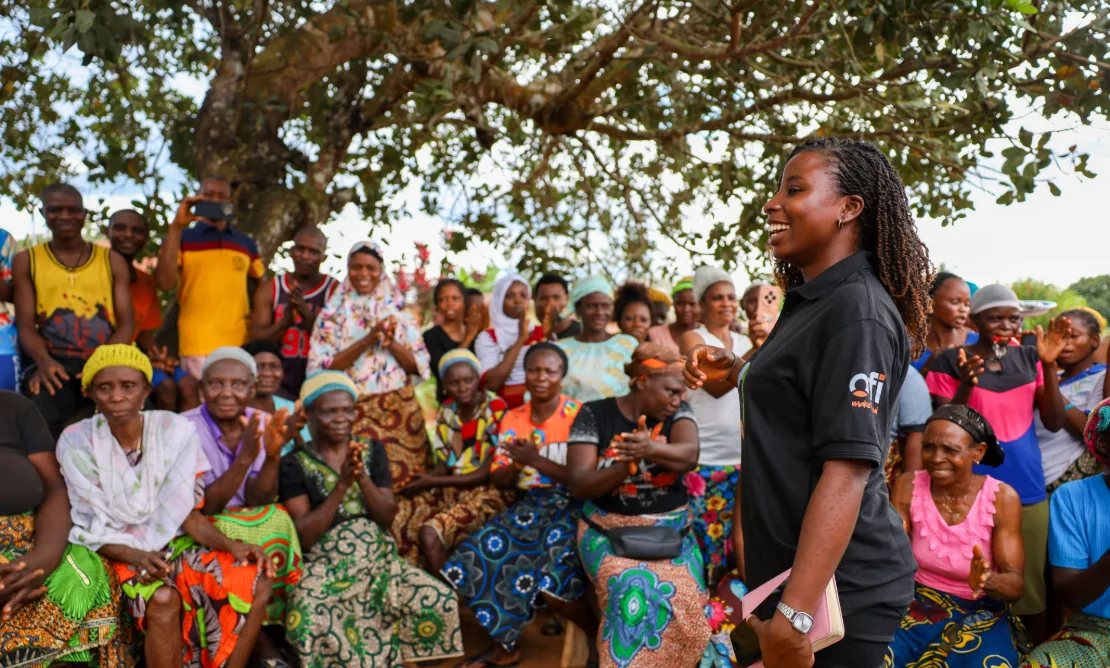
Only farmers who believe in the future of their farm will invest in quality, productivity and resilience. Living income helps us understand what it takes to get there.
Roel van Poppel, Chief Sustainability Officer, ofi
At ofi, we work across cocoa, coffee, dairy, nuts and spices, sourcing from around 2.75 million farmers globally. So, when we talk about farmer livelihoods, we're talking about something that sits at the heart of our business.
For us, a farmer's livelihood, and in line with that, a farmer earning a living income isn't just a social impact topic. It's fundamental to building resilient supply chains.
If a farmer doesn't believe there is a future in their farm, they won't invest in their farm. They will not take steps to structurally improve productivity. They will not be long-term focused. And therefore they'll be less effective taking on other priorities such as regenerative agriculture, climate adaptation or reducing human rights risks.
So, when we talk about livelihood and living income, we are really talking about the foundations of long-term resilience.
That's why farmer livelihoods are at the center of our Choices for Change sustainability strategy. We set ourselves targets for 2030:
for 1 million of the 2.75 million households we source from to provide livelihood support and for 200,000 ofi farmer households to achieve a living income
We may have reached the 200,000 living income target in 2025, five years earlier than planned. What was most important here wasn't whether we hit the number.
It was why.
One of the biggest lessons we've learned is that living income data is most useful when it challenges your assumptions.
Sometimes we assumed the biggest issue was price. But often the real constraint turned out to be something else: farm size, productivity, access to finance, or the lack of opportunities to earn income beyond a single crop.
The more we measured, the more we realised that living income wasn't simply giving us a result. It was helping us understand where to focus our action.
That's why we often describe living income as our North Star. Not because it solves the problem, but because it helps us understand where the gaps are and what is driving them.
The goal is then to turn those insights into better decisions on the ground. We still have work to do, but we're increasingly using the data to design more targeted support.
Because a farmer with a productivity challenge needs something different from a farmer with limited access to finance. A household with no additional income opportunities needs something different again.
So rather than applying one solution everywhere, we increasingly use the data to design more targeted support.
One example is our coffee livelihoods work in Honduras with ALDI SOUTH Group.
Over four years, we used our Living Income Calculator to understand the nature of the income gap for around 1,000 farmers and then shape practical support, from improved agronomy through to literacy training. Among the most vulnerable farmers, estimated average yields increased from 706 to 957 kilograms per hectare. We should always treat yield estimates with care, but it demonstrates the value of moving from measurement to targeted action.
We've seen something similar through income diversification programmes, such as supporting women cocoa farmers through beekeeping initiatives in Côte d'Ivoire. Because in many cases, strengthening resilience is not only about earning more from the same crop.
But there is another important lesson. Living income is systemic by definition. That's why we're deliberately modest about our 2025 results.
Yes, more than 200,000 farmer households in our supply chains recorded a living income. But a significant part of that progress was driven by higher cocoa and coffee prices, not by ofi interventions alone. And our own assessments still show persistent income gaps in several origins.
So we don't see this as target achieved, problem solved.
We see it as better visibility and a stronger understanding of where the work still needs to happen.
That's also why we're trying to make the methodology useful beyond ofi. We're working with partners including TRACT and IDH to expand access to the tools and learning we've developed. Because no single company can solve living income on its own.
If we want to help more farmers earn a living income, we need common approaches, better data and collaboration across companies, customers, governments, NGOs and farmers themselves.
So my message for this step of the roadmap is simple:
If we want to make progress on climate resilience, human rights and long-term supply security, then structurally improving farmer livelihoods has to be part of the answer.
That does not mean pretending this is simple. Livelihoods are shaped by local context, farm economics, markets, policy and the choices and constraints farmers face every day.
And it certainly is not something any one company can solve alone.
But when livelihoods are addressed effectively, living income can help unlock progress on many of the other issues we all care about.
That is why this work matters. And it is why we need to keep working together - with partners, customers, governments, NGOs and farmers themselves.