ofi’s Cocoa greenhouse gas (GHG) Natural Capital Costs have been reduced by 12% reduction per ton of output against its 2018 baseline
ofi also saw an uplift in cocoa farmers achieving a living income, largely driven by cocoa market price increases and livelihood support
ofi (Olam Food Ingredients), a global leader in naturally good food and beverage ingredients and solutions, is driving resilience in cocoa farming communities, to help secure the long-term supply security of cocoa ingredients for food and beverage manufacturers.
It’s latest Cocoa Compass Impact Report (2024) reveals ofi has surpassed its cocoa greenhouse gas (GHG) Natural Capital Cost1 reduction milestone2 target for 2024 with an overall 12% reduction per ton of output against its 2018 baseline.
It also reached its 2030 cocoa living income target, in collaboration with its customers and partners, with 155,000 farmers earning a living income, representing 45% of farmers in its global cocoa sustainability programs3.
ofi, Global Head of Cocoa Sustainability, Andrew Brooks said:
“We’re continuing to invest in farm-level engagement and ingredient innovation by leveraging the scale of our integrated business model. This enables us to de-risk supply chains, and help deliver more sustainable, high-quality cocoa ingredients and tailored food solutions to our customers that meet evolving consumer demands.
“Our latest impact in our cocoa supply chain is supporting our ambition of being the preferred partner for positive change, in line with our overarching sustainability strategy- Choices for Change. As we continue towards 2030, our focus will be on maintaining this progress and enable more sustainable outcomes for cocoa production against the unpredictability of fluctuating markets and climate changes.
ofi’s Cocoa Compass impact report marks the halfway point between the 2018 baseline for its Cocoa product sustainability strategy, and 2030 targets. Other key 2024 achievements in the report are:
9.8 million trees distributed for agroforestry programs(cumulative)
257,000 farmers trained in Good Agricultural Practices(annual)
320,000 cocoa farmers received livelihood support (annual)
6 active landscape partnerships(annual)
40,000 children received education support(annual)
Farmer incomes are influenced by multiple factors such as weather and markets prices, which has seen high volatility in the last three years. In 2024, it resulted in prices increasing sharply, influencing the increase in farmers earning a living income. Conversely, a drop in the market price in the future would have the opposite effect.
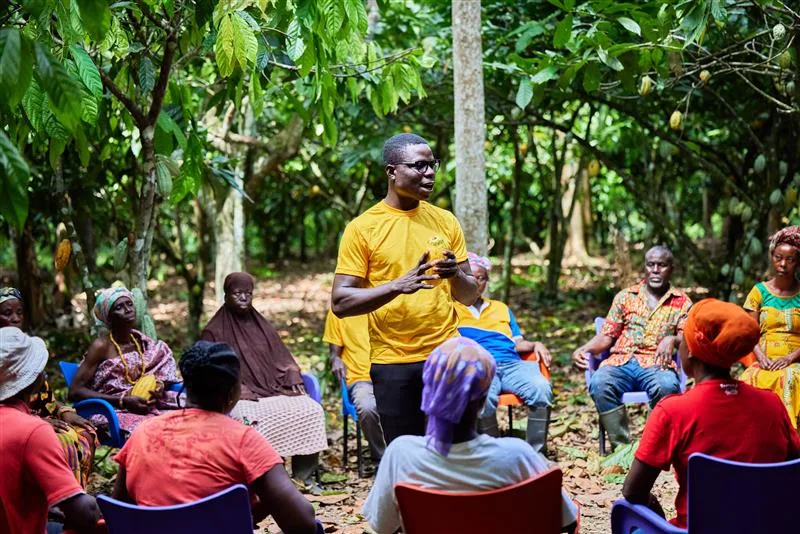
ofi is using living income as a valuable contextual indicator, serving as a north star to gauge economic status and guide its interventions. ofi’s Living Income progress is largely due to cocoa market price increases, and livelihood support. ofi has provided 320,000 farmers with livelihood support to help farmers be more resilient to the market and climate shocks. This approach enables tailored training and practical livelihood support to be delivered over multiple years, through long-term collaboration with our customers and partners.
Natural capital acknowledges the importance of nature to ofi, tracking its progress to mitigate against climate and environmental risks that could disrupt future supply. ofi’s Natural Capital progress, came from reductions in land-use change emissions, and sequestration from both cocoa and forest trees planted on farms as part of agroforestry activities.
ofi, Global Head of Cocoa Sustainability, Andrew Brooks continues “The industry, including governments and NGOs, need to rally together to rethink how we’re tackling challenges like crop disease, deforestation, particularly in West Africa. With cocoa crop reductions expected, and demand destruction already having an impact on product formulations, we need to find collective solution that is good for cocoa farmers, good for food and beverage processors and manufacturers, and good for consumers as well”.
ofi’s success delivered to date is built on the foundation of more than two decades of sustainability impact, in ofi’s direct cocoa sourcing countries, across diverse cocoa origins in Africa, South America and Asia Pacific regions.
For more information visit ofi.com
1 Natural Capital Accounting follows a holistic systems approach to understanding the true value of nature, people, society for humans. The economy must be recognized as parts within a deeply interconnected global system and addressed together to deliver value across the capitals. It is an approach to measure the changes in the stock of natural capital at a variety of scales and to integrate the value of ecosystem services into accounting and reporting systems at national, corporate, project and product levels. This will result in better management of natural capital by these different entities.
2 2024 cocoa milestone in GHG natural capital costs was a 10% reduction (against the 2018 baseline). The 2030 target is a 30% reduction in GHG Natural Capital cost since 2018.
3 We adopt the guidance of the Living Income Community of Practice (LICOP): “The net annual income required for a household in a particular place to afford a decent standard of living for all members of that household. Elements of a decent standard of living include food, water, housing, education, healthcare, transport, clothing, and other essential needs including provision for unexpected events.”
ofi's cocoa living income 2030 target is 150,000 earning a living income. Its 2024 cocoa milestone was 60,000 earning a living income.